2020
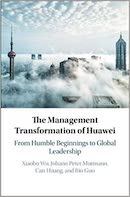
Xu, Hongqi; Murmann, Johann Peter
The Transformation of Huawei’s HR System Book Chapter
In: Wu, Xiaobo; Murmann, Johann Peter; Huang, Can; Guo, Bin (Ed.): The Management Transformation of Huawei: From Humble Beginnings to Global Leadership, Chapter 6, pp. 209–243, Cambridge University Press, 2020.
@inbook{xu_murmann_wu_murmann_huang_guo_2020,
title = {The Transformation of Huawei’s HR System},
author = {Hongqi Xu and Johann Peter Murmann },
editor = {Xiaobo Wu and Johann Peter Murmann and Can Huang and Bin Guo},
doi = {10.1017/9781108550987.007},
year = {2020},
date = {2020-01-01},
urldate = {2020-01-01},
booktitle = {The Management Transformation of Huawei: From Humble Beginnings to Global Leadership},
pages = {209–243},
publisher = {Cambridge University Press},
chapter = {6},
abstract = {To facilitate its rapid growth over the past thirty years and build an increasingly capable management team and workforce, Huawei made substantial changes to its HR practices. As the number of employees increased, the firm faced different challenges in recruiting, developing, and motivating employees while broadening its geographic focus from China to all corners of the globe. To accurately describe the changes Huawei made to address these challenges, we divide the history of Huawei’s HR system into five distinct stages that we call (1) personnel management, (2) the beginning of human resource management, (3) strategic human resource management, (4) international human resource management, and (5)talent management. With the help of Western consulting firms, Huawei imported many Western HR practices and combined them with the Chinese tradition of cultivating a strong commitment to a large organization. Huawei also adapted Western ideas. For example, it required employees to pay for their own training costs at the company university.},
keywords = {Change, HR Systems, Huawei, Routines},
pubstate = {published},
tppubtype = {inbook}
}
To facilitate its rapid growth over the past thirty years and build an increasingly capable management team and workforce, Huawei made substantial changes to its HR practices. As the number of employees increased, the firm faced different challenges in recruiting, developing, and motivating employees while broadening its geographic focus from China to all corners of the globe. To accurately describe the changes Huawei made to address these challenges, we divide the history of Huawei’s HR system into five distinct stages that we call (1) personnel management, (2) the beginning of human resource management, (3) strategic human resource management, (4) international human resource management, and (5)talent management. With the help of Western consulting firms, Huawei imported many Western HR practices and combined them with the Chinese tradition of cultivating a strong commitment to a large organization. Huawei also adapted Western ideas. For example, it required employees to pay for their own training costs at the company university.