JPM on China
Johann Peter Murmann Writings on China
My Publications
Murmann, Johann Peter; Guo, Bin; Huang, Can A Dynamic Perspective on Huawei Journal Article In: Management and Organization Review, 17 (5), pp. 1087-1100, 2021. Abstract | Links | BibTeX | Tags: Change, Dynamic Capabilities, Huawei, Routines Murmann, Johann Peter The Management Transformation of Huawei: An Overview Book Chapter In: Wu, Xiaobo; Murmann, Johann Peter; Huang, Can; Guo, Bin (Ed.): The Management Transformation of Huawei: From Humble Beginnings to Global Leadership, pp. 1–70, Cambridge University Press, 2020. Abstract | Links | BibTeX | Tags: Change, Dynamic Capabilities, Evolutionary Theory, Huawei, Routines Wu, Xiaobo; Murmann, Johann Peter; Huang, Can; Guo, Bin The Management Transformation of Huawei: From Humble Beginnings to Global Leadership Book Cambridge University Press, 2020. Abstract | Links | BibTeX | Tags: Change, Dynamic Capabilities, Evolutionary Theory, Huawei, Routines Li, Lanhua; Guo, Bin; Murmann, Johann Peter; Wu, Dong Huawei’s R&D Management Transformation Book Chapter In: Wu, Xiaobo; Murmann, Johann Peter; Huang, Can; Guo, Bin (Ed.): The Management Transformation of Huawei: From Humble Beginnings to Global Leadership, Chapter 8, pp. 292–346, Cambridge University Press, 2020. Abstract | Links | BibTeX | Tags: Change, Dynamic Capabilities, Huawei, Innovation, R&D, Routines Murmann, Johann Peter The Management Transformation of Huawei: Concluding Thoughts from a Comparative Perspective Book Chapter In: Wu, Xiaobo; Murmann, Johann Peter; Huang, Can; Guo, Bin (Ed.): The Management Transformation of Huawei: From Humble Beginnings to Global Leadership, Chapter 10, pp. 381–410, Cambridge University Press, 2020. Abstract | Links | BibTeX | Tags: Dynamic Capabilities, Evolutionary Theory, Huawei, Private Enterprise, SOEs2021
@article{murmann_guo_huang_2021,
title = {A Dynamic Perspective on Huawei},
author = {Johann Peter Murmann and Bin Guo and Can Huang},
doi = {10.1017/mor.2021.31},
year = {2021},
date = {2021-01-01},
urldate = {2021-01-01},
journal = {Management and Organization Review},
volume = {17},
number = {5},
pages = {1087-1100},
publisher = {Cambridge University Press},
abstract = {Huawei is one of China’s most prominent multinational corporations (MNCs). As Huawei has been caught in the middle of a geopolitical struggle between China and the USA, Huawei received disproportionate attention in the Western press since 2018 when the US government stepped up its efforts to persuade other Western countries to ban Huawei’s 5G technology from their telecommunication infrastructures. We have been researching the development of Huawei into an MNC for several years, analyzing how Huawei managed to grow from 50 employees in 1987 to over 194,000 employees today (Huawei 2019). Our findings recently came out in a book entitled “The Management Transformation of Huawei: From Humble Beginnings to Global Leadership” (Wu et al. 2020). Like Yan, Hu and Dong (2021), we have been impressed by Huawei’s ability to transform itself. In our commentary, we will first consider Yan, Hu and Dong’s (2021) paper “The Transformation of Huawei Mobile: Managing Complementary Assets to Build Cross-Functional Ambidexterity” and then Hong and Snell’s (2021) paper “Headquarters Control and its Legitimation in a Chinese Multinational Corporation: The Case of Huawei.” Because the papers have such a different focus it makes sense to treat them individually and conclude with reflections that apply to both. },
keywords = {Change, Dynamic Capabilities, Huawei, Routines},
pubstate = {published},
tppubtype = {article}
}
2020
@inbook{murmann_wu_murmann_huang_guo_2020,
title = {The Management Transformation of Huawei: An Overview},
author = {Johann Peter Murmann},
editor = {Xiaobo Wu and Johann Peter Murmann and Can Huang and Bin Guo},
doi = {10.1017/9781108550987.002},
year = {2020},
date = {2020-01-01},
urldate = {2020-01-01},
booktitle = {The Management Transformation of Huawei: From Humble Beginnings to Global Leadership},
pages = {1–70},
publisher = {Cambridge University Press},
abstract = {This introductory chapter offers an overview of the entire book on the management transformation of Huawei. Huawei is now China’s most prominent multinational company and a leader in 5G mobile telephone technology, which will be rolled out across the world in the next few years. What makes Huawei interesting is its rate of growth and the level of detail in which we can observe not only the creation of routines but also the breaking of routines across most the major functional areas (management, product development, HR, supply chain, finance, R&D, intellectual property, and international). This makes Huawei an ideal case to advance the theory of routines and dynamic capabilities to change routines. Hence the book will particularly appeal to academics in the field of strategy, management, and business history.},
keywords = {Change, Dynamic Capabilities, Evolutionary Theory, Huawei, Routines},
pubstate = {published},
tppubtype = {inbook}
}
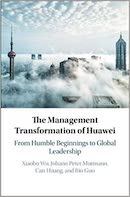
@book{wu_murmann_huang_guo_2020,
title = {The Management Transformation of Huawei: From Humble Beginnings to Global Leadership},
author = {Xiaobo Wu and Johann Peter Murmann and Can Huang and Bin Guo},
doi = {10.1017/9781108550987},
year = {2020},
date = {2020-01-01},
urldate = {2020-01-01},
publisher = {Cambridge University Press},
abstract = {Huawei has become China's most prominent multinational company and a leader in the ICT sector. Given unprecedented access to the company, the authors of this book examine the management transformation of Huawei from its inception in 1987 until 2019, observing in detail not only the creation of its organizational routines but also the breaking of routines across most major functional areas: Management, Product Development, HR, Supply Chain, Finance, R&D, Intellectual Property, and International Business. 'Dynamic capabilities' are central to theories of competitive advantage and this book highlights Huawei as an ideal case study for the successful implementation of change routines and change-supporting values. The chapters cover all the major change initiatives the firm has undertaken since 1996 to import best practices from the West, with the help of consultants. The insights presented in the book will be particularly interesting for academics in the field of strategy, management, and business history.},
keywords = {Change, Dynamic Capabilities, Evolutionary Theory, Huawei, Routines},
pubstate = {published},
tppubtype = {book}
}
@inbook{li_guo_murmann_wu_wu_murmann_huang_guo_2020,
title = {Huawei’s R&D Management Transformation},
author = {Lanhua Li and Bin Guo and Johann Peter Murmann and Dong Wu },
editor = { Xiaobo Wu and Johann Peter Murmann and Can Huang and Bin Guo},
doi = {10.1017/9781108550987.009},
year = {2020},
date = {2020-01-01},
urldate = {2020-01-01},
booktitle = {The Management Transformation of Huawei: From Humble Beginnings to Global Leadership},
pages = {292–346},
publisher = {Cambridge University Press},
chapter = {8},
abstract = {Although Huawei started its business as a small agent in 1987, the firm began the independent development of telecommunications equipment in its fouth year of operation and then gradually increased its R&D investments over the years. As the scale of R&D efforts increased, Huawei encountered significant problems with its organization of R&D and felt that it was necessary to transform how it conducts R&D several times over its thirty-year history. In this chapter, we develop a four-step model to analyze three major R&D management transformations in Huawei’s long history of R&D activities. The first transformation, from 1991 to 1995, helped Huawei to establish an informal R&D system; the second transformation, from 1995 to 1998, changed the informal R&D management system into a formal system with clear structures and processes; and finally, the third transformation built up a process-oriented, high-performing R&D organization. We find that although the transformations shifted Huawei’s focus from making structural changes to process changes, all of them were closely aligned with the firm’s market position and with its strategic re-orientation.},
keywords = {Change, Dynamic Capabilities, Huawei, Innovation, R&D, Routines},
pubstate = {published},
tppubtype = {inbook}
}
@inbook{murmann_wu_murmann_huang_guo_2020b,
title = {The Management Transformation of Huawei: Concluding Thoughts from a Comparative Perspective},
author = {Johann Peter Murmann },
editor = {Xiaobo Wu and Johann Peter Murmann and Can Huang and Bin Guo},
doi = {10.1017/9781108550987.011},
year = {2020},
date = {2020-01-01},
urldate = {2020-01-01},
booktitle = {The Management Transformation of Huawei: From Humble Beginnings to Global Leadership},
pages = {381–410},
publisher = {Cambridge University Press},
chapter = {10},
abstract = {This chapter offers concluding thoughts on the entire Huawei study – the totality chapters and commentaries. It offers comparative perspective by placing the firm in the larger context of corporations in China and to some extent in other countries. The comparison with many other firms throughout the entire book reveals that Huawei is among a select number of firms that are able grow at very high rates by continuously transforming themselves. Consistently investing at least 10 percent of sales starting on R&D at least since 1998 was an important ingredient of this growth. But the importation of western best practice routines and the steering of this process by the Huawei founder and the top management team underlie this ability to grow. Huawei stands out among many Chinese companies that internationalize by relying solely on organic growth rather than on growth through acquisitions. Huawei is also different from state-owned companies (SOEs) that dominate a number of sectors in the Chinese economy in that Huawei motivated a large fraction of employees by giving them shares in a profit-sharing plan so that hard working employees could make a substantial amount of money. Building all chapters, we provide advance management theory by articulating in detail the meta-routines that underpin Huawei’s dynamic capabilities. Finally, we discuss the challenges to future growth of the firm, including geopolitical cross-currents the firm currently finds itself in.},
keywords = {Dynamic Capabilities, Evolutionary Theory, Huawei, Private Enterprise, SOEs},
pubstate = {published},
tppubtype = {inbook}
}