JPM on China
Johann Peter Murmann Writings on China
My Publications
Murmann, Johann Peter The Rise of China and the Specter of a Superpower War: Avoiding the Curse of History at the Grassroots Journal Article In: Management and Organization Review, 20 (6), pp. 946–957, 2024. Abstract | Links | BibTeX | Tags: China, Innovation, Superpower Conflict Jiang, Hong; Murmann, Johann Peter Functional Knowledge versus Strategic Knowledge: What Type of Knowledge Matters Most for the Long-Term Performance of Startups Journal Article In: Management and Organization Review, 19 (3), pp. 417-461, 2023. Abstract | Links | BibTeX | Tags: China, Dye Industry, Innovation Jiang, Hong; Murmann, Johann Peter The Rise of China's Digital Economy: An Overview Journal Article In: Management and Organization Review, 18 (4), pp. 790–802, 2022. Abstract | Links | BibTeX | Tags: China, Innovation2024
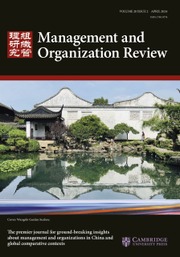
@article{Murmann_2024,
title = {The Rise of China and the Specter of a Superpower War: Avoiding the Curse of History at the Grassroots},
author = {Johann Peter Murmann},
doi = {10.1017/mor.2024.51},
year = {2024},
date = {2024-01-01},
urldate = {2024-01-01},
journal = {Management and Organization Review},
volume = {20},
number = {6},
pages = {946–957},
abstract = {Johann Peter Murmann’s “The Rise of China and the Specter of a Superpower War: Avoiding the Curse of History at the Grassroots” (2024) is both a scholarly reflection on China’s extraordinary economic ascent and a call for academic and civic engagement to prevent a new superpower conflict.
Murmann begins by tracing his decades-long research into innovation and industrial evolution, starting from the 19th-century synthetic dye industry. His early work on Germany’s leadership in dyes evolved into studying China’s dominance in that field after 1995. He attributes China’s success to regional policy variations, entrepreneurial dynamism, and local institutional flexibility—factors often underestimated in Western analyses.
As deputy editor of Management and Organization Review (MOR), Murmann focused on China’s transition from imitation to innovation. He co-edited China’s Innovation Challenge (2016), which debated whether China could avoid the “middle-income trap.” While Justin Lin predicted continued growth without systemic reform, Gordon Redding argued that reaching U.S. income levels required decentralization. Murmann’s empirical studies later confirmed China’s increasing innovation capacity between 2015–2020, though challenges remain in private-sector autonomy and academic freedom.
Examining sectors like digital technology, electric vehicles, and telecommunications, Murmann highlights how Chinese firms such as Huawei, Tencent, BYD, and NIO leveraged intense domestic competition, government support, and large-scale market experimentation to innovate globally. Yet this industrial rise parallels growing geopolitical tension with the United States. Drawing historical analogies to pre–World War I Germany and Britain, Murmann warns that structural rivalry could lead to catastrophic conflict—what Graham Allison terms “Thucydides’s Trap.”
Murmann concludes by urging educators, especially management scholars, to foster grassroots understanding between China and the West. Echoing Immanuel Kant and Chinese philosopher Kang Youwei, he envisions a “great community” of peaceful coexistence. He calls for intellectual exchange, humility, and dialogue to “bend the arc of history” away from war and toward mutual prosperity and perpetual peace.},
keywords = {China, Innovation, Superpower Conflict},
pubstate = {published},
tppubtype = {article}
}
Murmann begins by tracing his decades-long research into innovation and industrial evolution, starting from the 19th-century synthetic dye industry. His early work on Germany’s leadership in dyes evolved into studying China’s dominance in that field after 1995. He attributes China’s success to regional policy variations, entrepreneurial dynamism, and local institutional flexibility—factors often underestimated in Western analyses.
As deputy editor of Management and Organization Review (MOR), Murmann focused on China’s transition from imitation to innovation. He co-edited China’s Innovation Challenge (2016), which debated whether China could avoid the “middle-income trap.” While Justin Lin predicted continued growth without systemic reform, Gordon Redding argued that reaching U.S. income levels required decentralization. Murmann’s empirical studies later confirmed China’s increasing innovation capacity between 2015–2020, though challenges remain in private-sector autonomy and academic freedom.
Examining sectors like digital technology, electric vehicles, and telecommunications, Murmann highlights how Chinese firms such as Huawei, Tencent, BYD, and NIO leveraged intense domestic competition, government support, and large-scale market experimentation to innovate globally. Yet this industrial rise parallels growing geopolitical tension with the United States. Drawing historical analogies to pre–World War I Germany and Britain, Murmann warns that structural rivalry could lead to catastrophic conflict—what Graham Allison terms “Thucydides’s Trap.”
Murmann concludes by urging educators, especially management scholars, to foster grassroots understanding between China and the West. Echoing Immanuel Kant and Chinese philosopher Kang Youwei, he envisions a “great community” of peaceful coexistence. He calls for intellectual exchange, humility, and dialogue to “bend the arc of history” away from war and toward mutual prosperity and perpetual peace.2023

@article{jiang_murmann_2022,
title = {Functional Knowledge versus Strategic Knowledge: What Type of Knowledge Matters Most for the Long-Term Performance of Startups},
author = {Hong Jiang and Johann Peter Murmann},
doi = {10.1017/mor.2021.77},
year = {2023},
date = {2023-03-01},
urldate = {2023-03-01},
journal = {Management and Organization Review},
volume = {19},
number = {3},
pages = {417-461},
publisher = {Cambridge University Press},
abstract = {Past studies have shown that the flow of knowledge from incumbent firms is associated with the creation of startups and their subsequent performance. While much research has focused on the mechanisms of how incumbent-to-startup knowledge transfer takes place, such as entrepreneurs pursuing opportunities that their previous employers do not want to pursue, we explore with detailed qualitative analysis of six private startups in the Chinese synthetic-dye industry what type of knowledge actually flows and what type is more important for the long-term success of startups. We discover eight types of knowledge that flow from incumbents to new firms during the foundation of startups. Abstracting these eight types of knowledge into two general categories of functional knowledge and strategic knowledge, we find the reception of strategic (not functional) knowledge shapes the long-term competitiveness of surviving startups. Receiving technical knowledge – one type of functional knowledge – during the founding period is necessary for startups’ short-term survival but insufficient for long-term success. Our findings show that the performance implications of initial knowledge flows from incumbents hinge on the type of knowledge, contributing to a more explicit explanation of how incumbent-to-startup knowledge flows affect entrepreneurial performance.},
keywords = {China, Dye Industry, Innovation},
pubstate = {published},
tppubtype = {article}
}
2022

@article{jiang_murmann_2022b,
title = {The Rise of China's Digital Economy: An Overview},
author = {Hong Jiang and Johann Peter Murmann},
url = {https://u.pcloud.link/publink/show?code=XZdrWSVZ00bHtvQxTW7YQQalH06dKJXL3Loy},
doi = {10.1017/mor.2022.32},
year = {2022},
date = {2022-01-01},
urldate = {2022-01-01},
journal = {Management and Organization Review},
volume = {18},
number = {4},
pages = {790–802},
publisher = {Cambridge University Press},
abstract = {To stimulate a debate about the rise of China's digital economy, this essay compares China and the US in one key area of the digital economy – e-commerce and internet-based services. China still lags behind the US in internet penetration, but it distinguishes itself by building a mobile-first, fiber-intensive, and inclusive digital infrastructure. A favorable infrastructure, innovations tailored to the large Chinese market, and local firms’ rapid commercialization of products and services turned the world's largest domestic population into active online consumers, helping China overtake the US by a large margin in retail e-commerce and digital payment. While China translated digital technologies into leading business-to-customer and customer-to-customer businesses, it has not been so successful in business-to-business services. The US is still ahead in the general-purpose technologies underlying the digital economy.},
keywords = {China, Innovation},
pubstate = {published},
tppubtype = {article}
}